Buy o365.eu ?
We are moving the project
o365.eu .
Are you interested in purchasing the domain
o365.eu ?
domain@kv-gmbh.de · 0541-91531010
Buy o365.eu ?
When do I use 'o' or 'est-ce que'?
You can use both "o" and "est-ce que" to form questions in French. "O" is a more informal way to ask a yes/no question, while "est-ce que" is a more formal and structured way to form questions. "Est-ce que" is often used in written French or in formal situations, while "o" is commonly used in spoken French. **
What are the relative pronouns que, qui, qu', and o?
The relative pronouns que, qui, and qu' are used to introduce a subordinate clause that provides more information about a noun in the main clause. "Que" is used to refer to a direct object, "qui" is used to refer to the subject of the subordinate clause, and "qu'" is used before a vowel sound. "Où" is used to refer to a place or a time in the subordinate clause. These relative pronouns help to connect and provide more details about the noun in the main clause. **


Similar search terms for Que
Top-Angebote
Products related to Que:
-
Que Rico Rayas Bailarinas Raquel VaseThis Que Rico Vase Raquel - Rayas Bailarinas is perfect for displaying beautiful fresh flowers or a more permanent dried flower arrangement. Inspired by Spanish lifestyle this colourful Rayas Bailarinas pattern adds a warm and inviting look to your home with the gentle green lines against the beautiful curves of the vase. Handmade and hand painted for a truly unique finish, this vase also makes the perfect gift with the gift packaging included. Dimensions: 34.5(H) x 14(W) x 14(L)cm.52,00 £*Shipping: 0,00 £Secure redirect to the provider
-
Que Rico Fuego Floral Rodrigo VaseThis Que Rico Vase Rodrigo - Fuego Floral is perfect for displaying beautiful fresh flowers or a more permanent dried flower arrangement. Inspired by Spanish lifestyle this Fuego Floral pattern features a combo of pink and orange in a fun wavy design with matching orange handles. Handmade and hand painted for a truly unique finish, this vase also makes the perfect gift with the gift packaging included. Dimensions: 24.5(H) x 13(W) x 21(L)cm.48,00 £*Shipping: 3,50 £Secure redirect to the provider
-
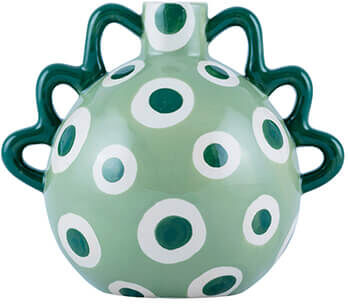
Que Rico Dancing Dots Isidora VaseThis Que Rico Vase Isidora - Dancing Dots is perfect for displaying beautiful fresh flowers or a more permanent dried flower arrangement. Inspired by Spanish lifestyle this Dancing Dots pattern features a colourful and bold design in green and white with a pair of wavy and stylish handles in green. Handmade and hand painted for a truly unique finish, this vase also makes the perfect gift with the gift packaging included. Dimensions: 16.5(H) x 15(W) x 20(L)cm.20,00 £*Shipping: 3,50 £Secure redirect to the provider
-
Que Rico Rosita Bolas Bailandas VaseBring warmth and personality to your home with the Qué Rico Rosita Bolas Bailandas Vase. Inspired by the vibrant colours and relaxed charm of Spanish living, this decorative ceramic vase is designed to brighten any interior. Designed in Belgium, the Rosita vase features a softly rounded silhouette decorated with a hand-painted circle pattern in rich shades of orange, pink and red. Its playful design adds a colourful accent to shelves, sideboards and coffee tables, whether styled with fresh flowers, dried stems or displayed as a standalone decorative piece. Each vase is individually hand-painted, making every piece unique and full of character. Beautifully presented in a gift box, it's a thoughtful choice for birthdays, housewarmings or anyone who loves distinctive home accessories. Dimensions: 15.5(H) x 12(W) x 12(D). Weight: 0.5kg. Care: Hand wash recommended.17,60 £*Shipping: 3,50 £Secure redirect to the provider



-
What is the difference between autant que and aussi que?
The main difference between "autant que" and "aussi que" is their usage in comparisons. "Autant que" is used to express equality in comparisons, meaning "as much as" or "as many as." For example, "Il mange autant que moi" (He eats as much as I do). On the other hand, "aussi que" is used to express similarity in comparisons, meaning "as... as." For example, "Elle est aussi belle que sa mère" (She is as beautiful as her mother). Therefore, "autant que" is used for equality, while "aussi que" is used for similarity in comparisons. **
-
What is the difference between "hay que" and "tener que"?
"Hay que" and "tener que" both express the idea of necessity, but they are used in slightly different contexts. "Hay que" is used to express a general obligation or necessity, often referring to a rule, law, or social norm. For example, "Hay que estudiar para tener buenas notas" (One must study to get good grades). On the other hand, "tener que" is used to express a specific obligation or necessity that is related to a particular person or situation. For example, "Tengo que terminar este informe antes de la reunión" (I have to finish this report before the meeting). **
-
How do you know when to use "tener que" or "hay que"?
"Tener que" is used when referring to a specific person or group of people who have an obligation or necessity to do something. For example, "Tengo que estudiar" (I have to study). On the other hand, "Hay que" is used when talking about a general obligation or necessity that applies to everyone. For example, "Hay que respetar las reglas" (One must respect the rules). So, the choice between "tener que" and "hay que" depends on whether the obligation is specific to an individual or more general. **
-
When is the subjunctive used with pienso que and no pienso que?
The subjunctive is used with "pienso que" when there is doubt, uncertainty, or subjectivity in the statement that follows. For example, "No pienso que venga a la fiesta" (I don't think he is coming to the party). In this case, the subjunctive "venga" is used because there is doubt about whether he will come. However, when there is certainty or a fact stated after "pienso que," the indicative mood is used. For example, "Pienso que ella viene a la fiesta" (I think she is coming to the party). **


What is the difference in Spanish between "ojalá que" and "espero que"?
The main difference between "ojalá que" and "espero que" in Spanish is the level of certainty or hope expressed. "Ojalá que" is used to express a wish or hope for something to happen, but with a sense of uncertainty or doubt about whether it will actually happen. On the other hand, "espero que" is used to express a hope or expectation for something to happen, with a stronger sense of confidence or belief that it will actually occur. In summary, "ojalá que" conveys a more uncertain hope, while "espero que" conveys a more confident hope. **
What does "qu'est-ce que" and "est-ce que" mean in French?
"Qu'est-ce que" means "what" in French and is used to form a question. For example, "Qu'est-ce que tu fais?" means "What are you doing?" On the other hand, "est-ce que" is a way to form a yes/no question in French. For example, "Est-ce que tu viens?" means "Are you coming?" **
Top-Angebote
Products related to Que:
-
Que Rico Leopardo Lindo Rosita VaseThis Que Rico Vase Rosita - Leopardo Lindo is perfect for displaying beautiful fresh flowers or a more permanent dried flower arrangement. Inspired by Spanish lifestyle this colourful Leopardo Lindo pattern adds a pop of colour to your home with this vibrant red and pink combination. Handmade and hand painted for a truly unique finish, this vase also makes the perfect gift with the gift packaging included. Dimensions: 16(H) x 11.5(W) x 11.5(L)cm.17,60 £*Shipping: 3,50 £Secure redirect to the provider
-
Que Rico Augusto Rayas Bailarinas VaseBring a fresh pop of colour to your home with the Qué Rico Augusto Rayas Bailarinas Vase. Designed in Belgium and inspired by the vibrant spirit of Spanish living, this decorative ceramic vase combines playful pattern with contemporary styling. Featuring a rounded organic silhouette and hand-painted green vertical stripes, the Augusto vase offers a striking balance of soft neutral tones and bold detailing. Whether filled with fresh flowers, arranged with dried stems or displayed as a standalone decorative piece, it adds character and warmth to any room. Each vase is individually hand-painted, making every piece wonderfully unique. Its generous proportions make it an eye-catching addition to shelves, console tables and dining spaces, while the included gift box makes it a thoughtful present for design lovers. Dimensions: 28.5(H) x 20(W) x 20(D). Weight: 1.6kg. Care: Hand wash recommended.56,00 £*Shipping: 0,00 £Secure redirect to the provider
-
Que Rico Rayas Bailarinas Raquel VaseThis Que Rico Vase Raquel - Rayas Bailarinas is perfect for displaying beautiful fresh flowers or a more permanent dried flower arrangement. Inspired by Spanish lifestyle this colourful Rayas Bailarinas pattern adds a warm and inviting look to your home with the gentle green lines against the beautiful curves of the vase. Handmade and hand painted for a truly unique finish, this vase also makes the perfect gift with the gift packaging included. Dimensions: 34.5(H) x 14(W) x 14(L)cm.52,00 £*Shipping: 0,00 £Secure redirect to the provider
-
Que Rico Fuego Floral Rodrigo VaseThis Que Rico Vase Rodrigo - Fuego Floral is perfect for displaying beautiful fresh flowers or a more permanent dried flower arrangement. Inspired by Spanish lifestyle this Fuego Floral pattern features a combo of pink and orange in a fun wavy design with matching orange handles. Handmade and hand painted for a truly unique finish, this vase also makes the perfect gift with the gift packaging included. Dimensions: 24.5(H) x 13(W) x 21(L)cm.48,00 £*Shipping: 3,50 £Secure redirect to the provider
-
When do I use 'o' or 'est-ce que'?
You can use both "o" and "est-ce que" to form questions in French. "O" is a more informal way to ask a yes/no question, while "est-ce que" is a more formal and structured way to form questions. "Est-ce que" is often used in written French or in formal situations, while "o" is commonly used in spoken French. **
-
What are the relative pronouns que, qui, qu', and o?
The relative pronouns que, qui, and qu' are used to introduce a subordinate clause that provides more information about a noun in the main clause. "Que" is used to refer to a direct object, "qui" is used to refer to the subject of the subordinate clause, and "qu'" is used before a vowel sound. "Où" is used to refer to a place or a time in the subordinate clause. These relative pronouns help to connect and provide more details about the noun in the main clause. **
-
What is the difference between autant que and aussi que?
The main difference between "autant que" and "aussi que" is their usage in comparisons. "Autant que" is used to express equality in comparisons, meaning "as much as" or "as many as." For example, "Il mange autant que moi" (He eats as much as I do). On the other hand, "aussi que" is used to express similarity in comparisons, meaning "as... as." For example, "Elle est aussi belle que sa mère" (She is as beautiful as her mother). Therefore, "autant que" is used for equality, while "aussi que" is used for similarity in comparisons. **
-
What is the difference between "hay que" and "tener que"?
"Hay que" and "tener que" both express the idea of necessity, but they are used in slightly different contexts. "Hay que" is used to express a general obligation or necessity, often referring to a rule, law, or social norm. For example, "Hay que estudiar para tener buenas notas" (One must study to get good grades). On the other hand, "tener que" is used to express a specific obligation or necessity that is related to a particular person or situation. For example, "Tengo que terminar este informe antes de la reunión" (I have to finish this report before the meeting). **
Similar search terms for Que
-
Que Rico Dancing Dots Isidora VaseThis Que Rico Vase Isidora - Dancing Dots is perfect for displaying beautiful fresh flowers or a more permanent dried flower arrangement. Inspired by Spanish lifestyle this Dancing Dots pattern features a colourful and bold design in green and white with a pair of wavy and stylish handles in green. Handmade and hand painted for a truly unique finish, this vase also makes the perfect gift with the gift packaging included. Dimensions: 16.5(H) x 15(W) x 20(L)cm.20,00 £*Shipping: 3,50 £Secure redirect to the provider
-
Que Rico Rosita Bolas Bailandas VaseBring warmth and personality to your home with the Qué Rico Rosita Bolas Bailandas Vase. Inspired by the vibrant colours and relaxed charm of Spanish living, this decorative ceramic vase is designed to brighten any interior. Designed in Belgium, the Rosita vase features a softly rounded silhouette decorated with a hand-painted circle pattern in rich shades of orange, pink and red. Its playful design adds a colourful accent to shelves, sideboards and coffee tables, whether styled with fresh flowers, dried stems or displayed as a standalone decorative piece. Each vase is individually hand-painted, making every piece unique and full of character. Beautifully presented in a gift box, it's a thoughtful choice for birthdays, housewarmings or anyone who loves distinctive home accessories. Dimensions: 15.5(H) x 12(W) x 12(D). Weight: 0.5kg. Care: Hand wash recommended.17,60 £*Shipping: 3,50 £Secure redirect to the provider
-
Que Rico Nicolás Rayas Bailarinas VaseBring character and colour to your home with the Qué Rico Nicolás Rayas Bailarinas Vase. Designed in Belgium and inspired by the relaxed energy of Spanish interiors, this distinctive ceramic vase pairs playful design with artisan craftsmanship. The Nicolás vase features a softly sculpted silhouette complemented by expressive wavy handles and hand-painted light blue vertical stripes. Whether styled with fresh flowers, dried botanicals or displayed on its own, it creates an instant focal point on a shelf, sideboard or dining table. Each vase is individually hand-painted, making every piece subtly unique and full of personality. Presented in a gift box, it also makes a thoughtful housewarming, birthday or interior design gift. Dimensions: 18(H) x 16.5(W) x 9.5(D)cm. Weight: 0.6kg. Care: Hand wash recommended.28,80 £*Shipping: 3,50 £Secure redirect to the provider
-
Que Rico Celestino Candy Crush VaseAdd a playful burst of colour to your interior with the Qué Rico Celestino Candy Crush Vase. Designed in Belgium and inspired by the vibrant spirit of Spanish living, this decorative ceramic vase combines bold pattern with contemporary styling. The Celestino vase features a sculptural geometric silhouette finished with a hand-painted checkerboard design in striking red and pink tones. Its compact size and distinctive shape make it ideal for displaying fresh flowers, dried stems or as a standalone decorative accent on shelves, side tables and mantelpieces. Each vase is individually hand-painted, ensuring every piece has its own unique character and artisanal charm. Presented in a gift box, it makes a thoughtful gift for anyone who loves colourful home décor and statement accessories. Dimensions: 17.5(H) x 10(W) x 10(D)cm. Weight: 0.4kg. Care: Hand wash recommended.19,20 £*Shipping: 3,50 £Secure redirect to the provider
-
How do you know when to use "tener que" or "hay que"?
"Tener que" is used when referring to a specific person or group of people who have an obligation or necessity to do something. For example, "Tengo que estudiar" (I have to study). On the other hand, "Hay que" is used when talking about a general obligation or necessity that applies to everyone. For example, "Hay que respetar las reglas" (One must respect the rules). So, the choice between "tener que" and "hay que" depends on whether the obligation is specific to an individual or more general. **
-
When is the subjunctive used with pienso que and no pienso que?
The subjunctive is used with "pienso que" when there is doubt, uncertainty, or subjectivity in the statement that follows. For example, "No pienso que venga a la fiesta" (I don't think he is coming to the party). In this case, the subjunctive "venga" is used because there is doubt about whether he will come. However, when there is certainty or a fact stated after "pienso que," the indicative mood is used. For example, "Pienso que ella viene a la fiesta" (I think she is coming to the party). **
-
What is the difference in Spanish between "ojalá que" and "espero que"?
The main difference between "ojalá que" and "espero que" in Spanish is the level of certainty or hope expressed. "Ojalá que" is used to express a wish or hope for something to happen, but with a sense of uncertainty or doubt about whether it will actually happen. On the other hand, "espero que" is used to express a hope or expectation for something to happen, with a stronger sense of confidence or belief that it will actually occur. In summary, "ojalá que" conveys a more uncertain hope, while "espero que" conveys a more confident hope. **
-
What does "qu'est-ce que" and "est-ce que" mean in French?
"Qu'est-ce que" means "what" in French and is used to form a question. For example, "Qu'est-ce que tu fais?" means "What are you doing?" On the other hand, "est-ce que" is a way to form a yes/no question in French. For example, "Est-ce que tu viens?" means "Are you coming?" **
* All prices are inclusive of VAT and, if applicable, plus shipping costs. The offer information is based on the details provided by the respective shop and is updated through automated processes. Real-time updates do not occur, so deviations can occur in individual cases. ** Note: Parts of this content were created by AI.